A2A vs MCP: Which Protocol Fits Your AI Agent Stack?

Senior Cybersecurity Analyst
TL;DR:
- MCP connects an AI application to tools and context. It gives a host a standard way to discover and invoke capabilities exposed by servers.
- A2A connects an agent to another agent. It is designed for delegated work that may have its own identity, state, progress, and artifacts.
- The protocols solve different boundaries. Use MCP when one agent needs a dependable tool. Use A2A when an independent agent must own part of the reasoning or workflow.
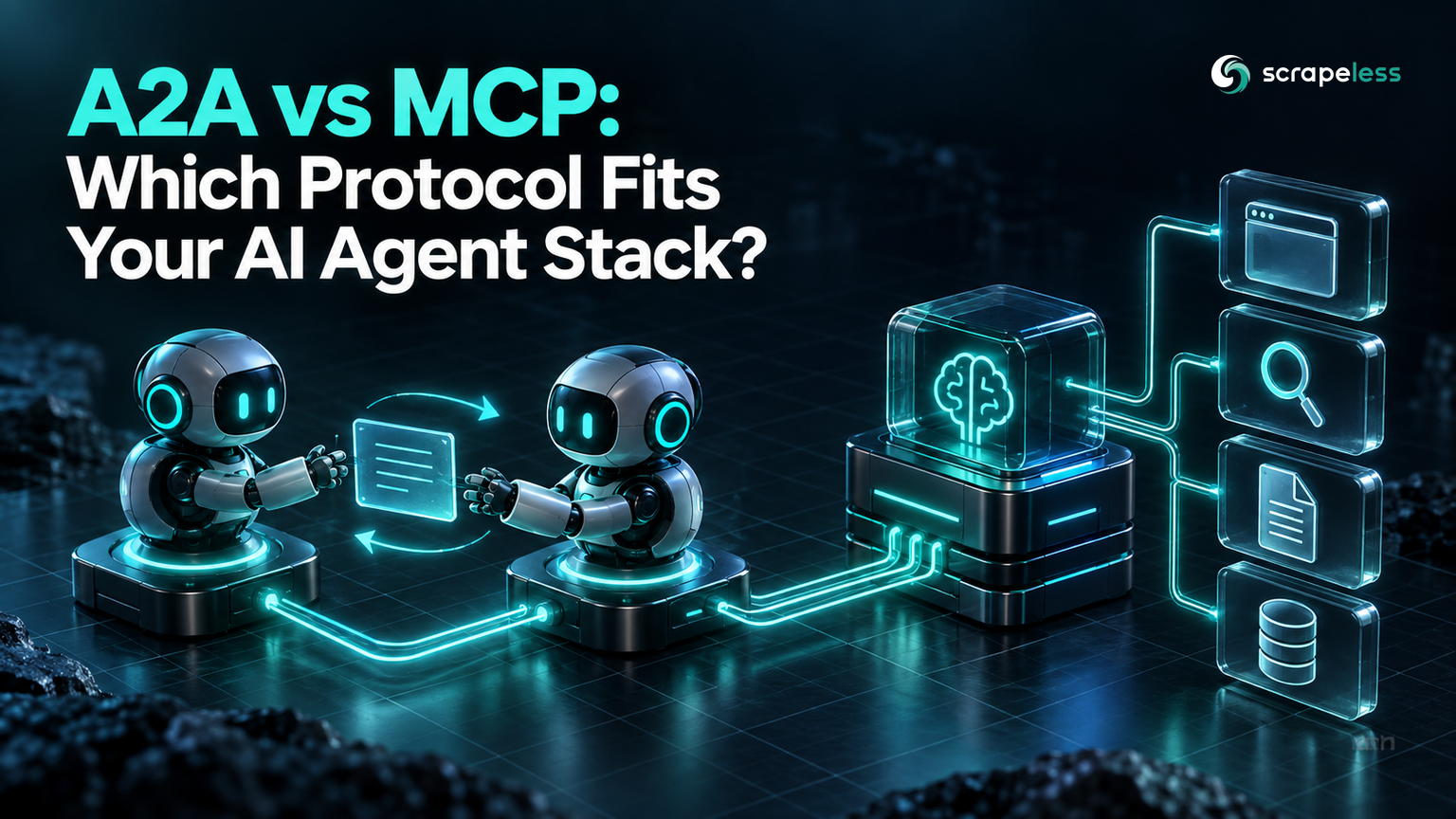
- Many systems need both. An orchestrating agent can delegate a task over A2A, while the remote agent uses MCP servers to search, browse, query data, or act on external systems.
- Choose the smaller trust boundary first. A typed MCP tool is usually easier to authorize, observe, and test than a second autonomous agent.
- Free to start. New Scrapeless accounts include free Scraping Browser runtime — sign up at app.scrapeless.com.
Introduction: two protocols, two jobs
Agent systems often reach a point where one model needs help. That help might be a search tool, a database query, or a browser session. It might also be another agent that owns a specialized workflow and returns a finished artifact. Those are different integration problems, even if both begin with a message sent over a network.
MCP and A2A separate those problems cleanly. MCP standardizes the connection between an AI application and external capabilities. A2A standardizes communication with an independent agent. The distinction matters because it changes who owns the reasoning, the state, and the final decision.
This guide compares the two protocols by purpose, message flow, discovery, lifecycle, security, and fit. It also shows where the Scrapeless MCP Server belongs in a mixed agent stack.
What Is MCP?
Model Context Protocol is a client-server protocol for giving an AI application access to tools, resources, and reusable prompts. The host application creates a client connection to each MCP server, negotiates capabilities, and decides how exposed capabilities enter the model's working context.
The official MCP architecture specification defines a host-client-server model with isolated server connections. That model is a good fit for capabilities that should remain narrow and inspectable: search a catalog, fetch a public page, read a file, or execute a defined action.
MCP tools are described with names and input schemas. The model can select a tool, but the host still controls which server is connected, what the model can see, and whether a sensitive action needs user approval. Resources and prompts cover context that does not need to behave like an executable function.
The practical question is simple: can the requested capability be represented as a bounded call with a clear input and output? If yes, MCP is usually the first protocol to consider.
What Is A2A?
Agent2Agent Protocol is for communication between independent agents. The remote side is not just a tool implementation. It may plan, ask follow-up questions, maintain task state, produce several artifacts, or coordinate its own tools before replying.
The A2A protocol specification describes messages, stateful tasks, artifacts, streaming updates, push notifications, and Agent Cards. An Agent Card publishes an agent's identity, endpoint, skills, supported interfaces, and authentication requirements so another system can decide whether and how to delegate work.
A2A is useful when the remote agent must stay operationally separate. It may run in another team, framework, cloud, or organization. The caller can delegate an outcome without importing the remote agent's internal prompts, memory, models, or tool chain.
A2A vs MCP at a Glance
| Decision area | MCP | A2A |
|---|---|---|
| Primary connection | AI application to tool or context server | Agent to independent agent |
| Remote responsibility | Execute a defined capability | Reason about and own delegated work |
| Discovery unit | Tools, resources, and prompts | Agent identity, skills, interfaces, and policies |
| Typical state | Session and capability state | Conversation and task lifecycle state |
| Output | Typed tool content or resource data | Message, task status, and artifacts |
| Best fit | Bounded actions and data access | Cross-system delegation and long-running work |
| Main governance question | Which tools may this host expose? | Which agent may receive this task and context? |
Both protocols can carry structured messages. The difference is the contract around the other endpoint. MCP treats the server as a provider of capabilities. A2A treats the server as an agent that can own part of the work.
Choose MCP When the Capability Has a Clear Contract
MCP is the stronger default when the caller should remain the only reasoning authority. Common cases include:
- Search and retrieval. The agent needs current evidence from a defined source.
- Browser actions. The agent needs a page rendered, clicked, read, or captured.
- Database and file access. The host wants strict schemas and narrow permissions.
- Deterministic business operations. The remote system performs an action but does not reinterpret the goal.
- Reusable context. Several hosts need access to the same prompts or resources.
This shape is easier to test because each capability can have an explicit schema and acceptance condition. It is also easier to authorize because the host can expose only the tools needed for the current task.
Start Scraping with Scrapeless
Power up your web scraping and automation workflow with Scrapeless!
Sign up today and get $5 in free credit — no credit card required.Claim your free credit now in the Scrapeless Dashboard.
Choose A2A When Another Agent Must Own the Work
A2A earns its extra boundary when delegation is the requirement, not merely an implementation choice. Use it when:
- The remote system has its own reasoning loop. The caller requests an outcome rather than invoking a fixed function.
- Work has a meaningful lifecycle. The task may remain active while progress events and partial artifacts arrive.
- The agents belong to different systems. Each side keeps its own framework, models, prompts, and state.
- The remote agent may negotiate. It can ask for missing context or reject work outside its declared skills.
- The artifact matters more than the call. A report, plan, or generated file is the natural result.
An A2A connection expands the trust boundary. The remote agent may make decisions and call its own tools. Authorization should therefore cover the delegated objective, the shared context, and the returned artifacts, not just an endpoint name.
How MCP and A2A Work Together
The protocols compose well because they sit at different layers:
- A coordinator receives a user goal.
- It discovers a specialist through an A2A Agent Card.
- It delegates a bounded outcome and tracks the task.
- The specialist uses MCP servers for search, browsing, files, or databases.
- The specialist returns an artifact through A2A.
- The coordinator reviews the artifact and decides what happens next.
The message envelopes may use familiar remote-procedure-call patterns, but shared syntax does not make the trust models identical. The JSON-RPC specification defines request, response, notification, and error objects. MCP and A2A add their own capability, lifecycle, and discovery semantics above transport-level messaging.
A good architecture keeps each boundary visible. MCP tool calls should remain narrow. A2A tasks should state the delegated outcome and the context the remote agent may use. Logs should preserve which agent requested each tool call and which artifact came back.
Security and Governance Questions to Ask
Protocol choice does not remove the need for authorization. It changes where authorization must be enforced.
For MCP, review the server list, tool schemas, credential scope, and user-consent flow. Treat tool descriptions and returned content as untrusted input. Keep high-impact actions behind explicit confirmation and record the arguments actually sent.
The OAuth security best practices provide a useful baseline for token handling and authorization flows when either protocol crosses a service boundary.
For A2A, add agent identity, Agent Card provenance, task-level data sharing, artifact validation, and cancellation behavior. A remote agent can be competent and still be inappropriate for a particular data boundary. Signed discovery metadata and transport security help, but policy must still decide which tasks may cross the boundary.
The safest design grants the smallest useful capability. If a task can be expressed as one search call, expose one search tool. If the remote party truly needs to reason independently, delegate a limited outcome and validate its artifact before downstream use.
Where Scrapeless Fits
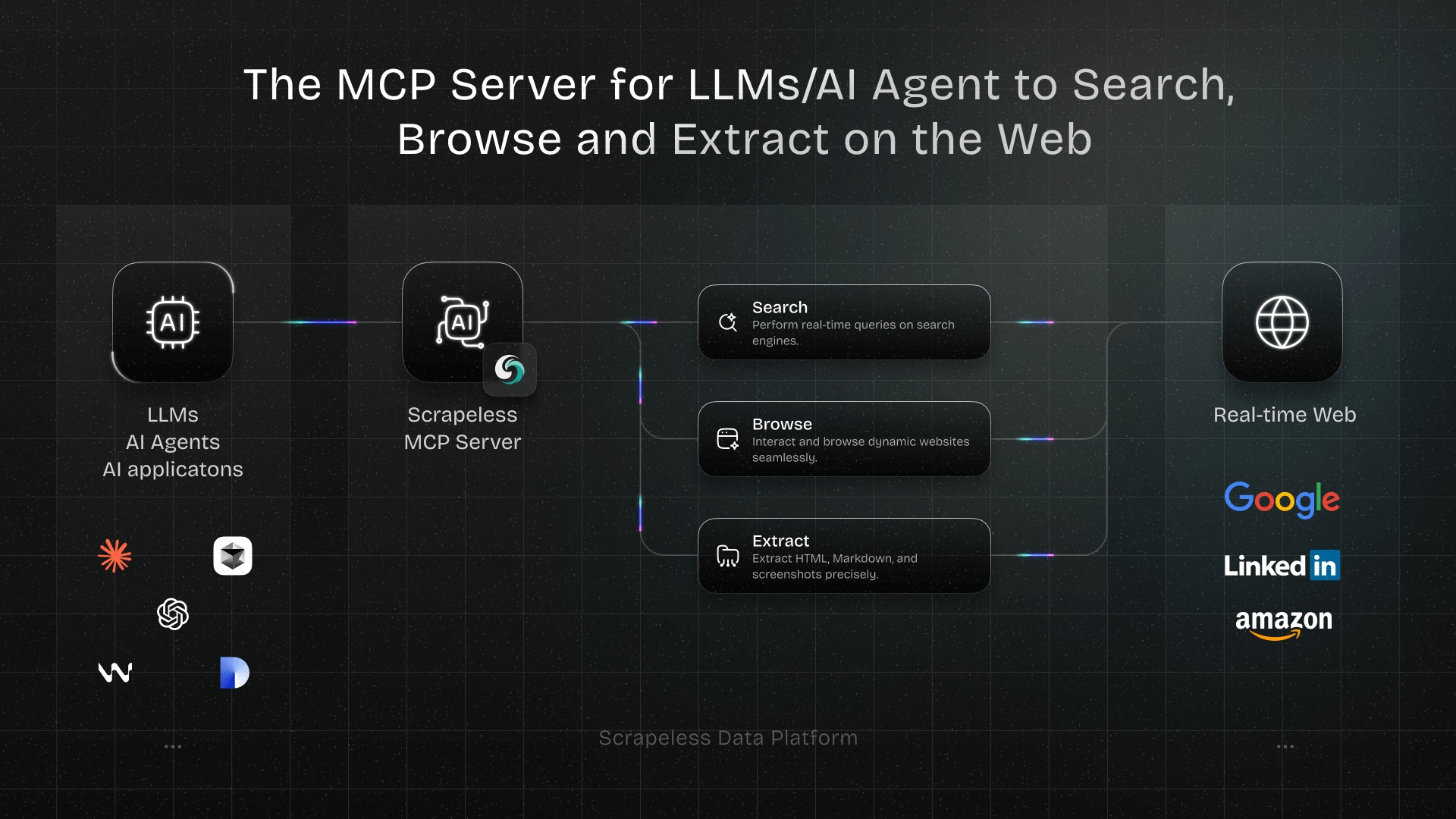
Scrapeless belongs on the MCP side of this architecture. The hosted server gives MCP-capable agents typed access to live search, page extraction, and browser interaction. The agent keeps control of the plan while Scrapeless handles the web-access layer.
That makes Scrapeless useful inside either topology. A single agent can connect directly to the server. In a multi-agent system, each specialist can use the same web-data capabilities without turning the browser itself into another autonomous agent.
Start with the Scrapeless AI Agent Browser, check the current pricing, and use the Scrapeless documentation to connect the server to your chosen MCP host.
Conclusion: choose the boundary before the protocol
A2A vs MCP is not a winner-takes-all comparison. MCP exposes tools and context to an AI application. A2A delegates work to an independent agent. The right choice follows from who should own the reasoning and state.
Begin with MCP when a clear tool contract is enough. Add A2A when organizational separation, independent progress, or specialist autonomy is part of the requirement. If both are present, keep the layers explicit: A2A for delegation, MCP for capabilities.
Ready to Build a Web-Connected Agent Stack?
Join the Scrapeless Discord community or Telegram community to compare agent architectures, then create a Scrapeless account when your agents need live web tools.
FAQ
Q: What is the main difference between A2A and MCP?
MCP connects an AI application to tools, resources, and prompts. A2A connects one agent to an independent remote agent that can own reasoning, state, and artifacts.
Q: Is A2A a replacement for MCP?
No. They address different layers. An A2A agent can use MCP servers internally, and an MCP host can remain useful without any A2A connection.
Q: Should a new agent project start with MCP or A2A?
Start with MCP when the needed capability can be expressed as a bounded tool call. Add A2A only when another agent must remain independent and own part of the task.
Q: Can MCP support long-running work?
MCP can expose task-oriented tools and progress features, but A2A makes a remote agent and its task lifecycle the central abstraction. Choose based on the ownership boundary, not duration alone.
Q: Can Scrapeless be used inside an A2A agent?
Yes. A remote A2A agent can connect to the Scrapeless MCP Server and use its search, extraction, and browser tools while completing delegated work.
Q: What should be logged in a combined MCP and A2A system?
Record the requesting agent, delegated task, MCP server and tool name, sanitized arguments, user approvals, returned content, and final artifact lineage.
At Scrapeless, we only access publicly available data while strictly complying with applicable laws, regulations, and website privacy policies. The content in this blog is for demonstration purposes only and does not involve any illegal or infringing activities. We make no guarantees and disclaim all liability for the use of information from this blog or third-party links. Before engaging in any scraping activities, consult your legal advisor and review the target website's terms of service or obtain the necessary permissions.